A fresh VM for every CI job
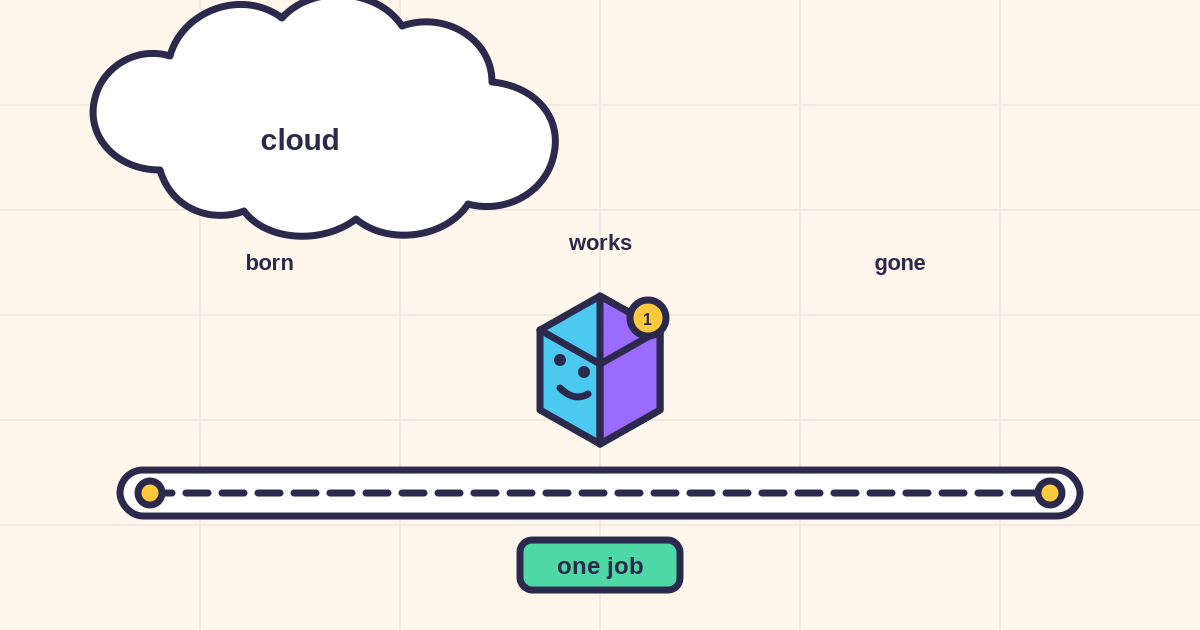
Every substantial CI job in my main project runs on a VM that did not exist before the job and will not exist after it. This page is the fleet: what a runner is, the eight pools, the ceilings, where the credentials are allowed to go, and what I have not measured yet.
- 8 pools, by purpose
- 89 workers, global ceiling
- 3 regions with vCPU caps
- 0 bytes cached between jobs
Job 01 · The rule
Nothing survives the job
A job gets a fresh cloud VM. The VM registers one just-in-time runner, so the registration is good for exactly one job. Storage is local NVMe. Nothing is cached between jobs. Container images are built on the VM. When the job ends, the VM is destroyed.
A runner that cannot carry state from one job to the next cannot leak it either, and a green build cannot be green because of something a previous job left behind. The price is that every job pays for its own setup. I have not measured that price yet, which is the subject of the last section.
Job 02 · Pools
Eight pools, three sizes
Pools are split by purpose. Rust and ARM get the big VMs. Control and review get the small ones. Everything else runs on the middle size.
Global ceiling: 89 workers. 81 for workload, 8 reserved for control.
Control
control-plane jobs
2 vCPU · 8 GiB
x64
x64 jobs
8 vCPU · 32 GiB
Rust
Rust builds and tests
16 vCPU · 64 GiB
ARM
ARM jobs
16 vCPU · 64 GiB
End-to-end
end-to-end tests
8 vCPU · 32 GiB
Review
review jobs
2 vCPU · 8 GiB
Benchmark
benchmarks
8 vCPU · 32 GiB
PR benchmark
benchmarks on a PR head
8 vCPU · 32 GiB
Job 03 · Ceilings
What fits where
Two limits apply before a VM is created. The fleet ceiling of 89 workers, and the vCPU cap of the region the VM would land in. The caps are 320, 160 and 248. A cap is a ceiling. What the fleet checks before each VM is the quota actually left.
- Region A320 vCPU cap
VMs fit, if the region is empty
- Region B160 vCPU cap
VMs fit, if the region is empty
- Region C248 vCPU cap
VMs fit, if the region is empty
Across the three regions: VMs of this size, against a fleet ceiling of 89. Before each VM is created, the real quota is checked, not this number.
Job 04 · Credentials
Where a secret may go
Hosted runner service
gate jobs without credentials
A job that needs no secret can run anywhere, so it runs here.
Disposable fleet
every job with a credential
A job that holds a secret runs on a VM that is destroyed when it ends.
The split is one rule, and it keeps the fleet free for the jobs that need it. A secret never lands on a machine that will still exist tomorrow.
Job 05 · Not measured
What I do not know yet
- Wall-clock per PR. From push to all gates green. Not collected.
- Cost per job and per day. The fleet is cloud VMs, so the number exists. I have not pulled it.
- A runner's real lifecycle timings. Queued, created, registered, running, destroyed, with timestamps. The figure above has the stations and none of the times.
When these exist they replace this section. Until then, this page does not claim the fleet is cheap or fast.
Job 06 · Rebuild it
The blueprint
- One fresh VM per substantial job. Local NVMe. No shared cache. Containers built on the VM.
- One just-in-time runner registration per VM. It serves one job and is never reused.
- Destroy the VM when the job ends, whatever the result.
- Pools by purpose. Here: control, x64, Rust, ARM, end-to-end, review, benchmark, PR benchmark. Three sizes: 2 vCPU with 8 GiB, 8 with 32, 16 with 64.
- A global ceiling with a reserved slice for control. Here: 89, of which 8 reserved.
- A vCPU cap per region, and a check of the real remaining quota before every VM is created. Here: 320, 160 and 248 across three regions.
- Credential-free jobs on a hosted runner service. Every job with a credential on the fleet.
- Measure wall-clock per PR, cost per job and the lifecycle timings before you decide the fleet is worth it.
The orchestration side is on How I run a software factory with agents.